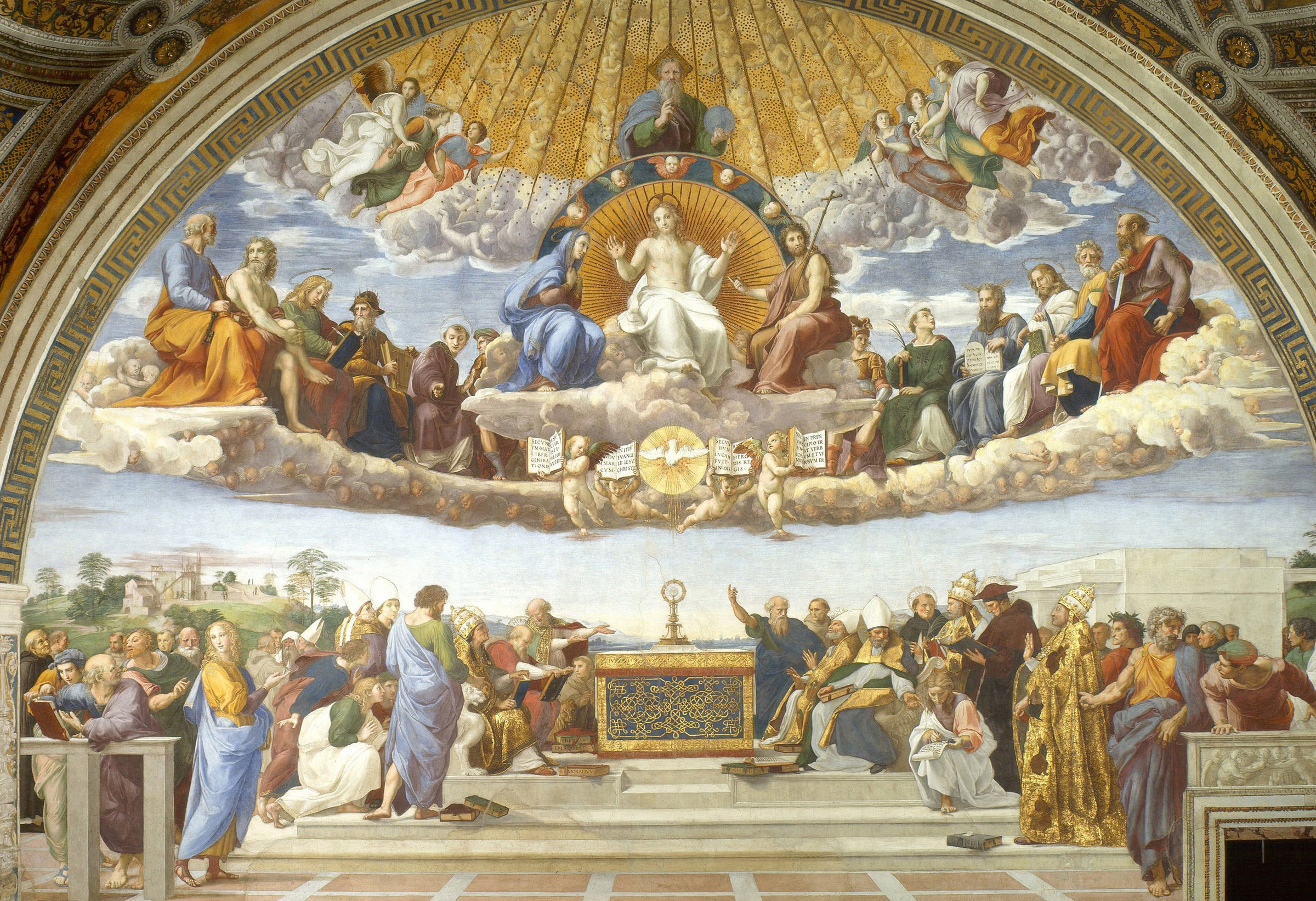
Raphael, The Disputation of the Holy Sacrament, 1509–1510. Vatican Museums. Public domain.
Contents
2 pieces
-
Covenantal Non-Dogmatism
Prolegomena to a Theory of Doctrine in LDS Thought
Noah Airmet
This essay proposes Covenantal Non-Dogmatism (CND) as a second-order account of how teachings acquire binding force in Latter-day Saint life. Rather than reconstructing a hidden catechism from the tradition’s many sources, it argues that the Church binds its members primarily through covenants, ordinances, worship, and priesthood order, with assent required only at a thin but real dogmatic floor. Beginning with a fallibilist account of revelation, the essay tests this covenantal framework against hard historical cases and argues that Mormonism’s unfinished theological territory is a constructive feature of an open-canon faith rather than a deficiency.
-
Preserving “True” Doctrine
How the Church of Jesus Christ of Latter-day Saints Uses Technical Communication to Maintain Orthodox Thought
Brigham Powelson, Brigham Young University-Idaho
This study examines how the Church of Jesus Christ of Latter-day Saints utilizes technical communication to establish, maintain, and preserve orthodox thought. Defining technical communication as the transmittal of needed information for correct audience comprehension, the paper posits a dual-aspect definition of doctrine based on scriptural canon and regular apostolic teachings. It then explores three primary grassroots influences that challenge institutional homogeneity: culture (particularly American Protestant individualism and creationist thought), tradition (such as the Sweetwater River pioneer narrative and the historical priesthood ban), and enthusiastic amateurs (theological speculation filling institutional gaps, such as the identity of Heavenly Mother). The study contrasts official correlation channels with non-church publications, apologetics organizations, and independent foundations, arguing that the preservation of orthodoxy increasingly relies on educated lay members who engage in scholarly technical communication on behalf of the Church. Ultimately, it suggests that further research is needed to determine the viability of creed-like doctrinal statements in an open-canon faith.